
IVF information · 6 / 9
Steps in IVF treatment
This page describes the steps that follow ovarian stimulation. Details differ for each person.
Egg collection
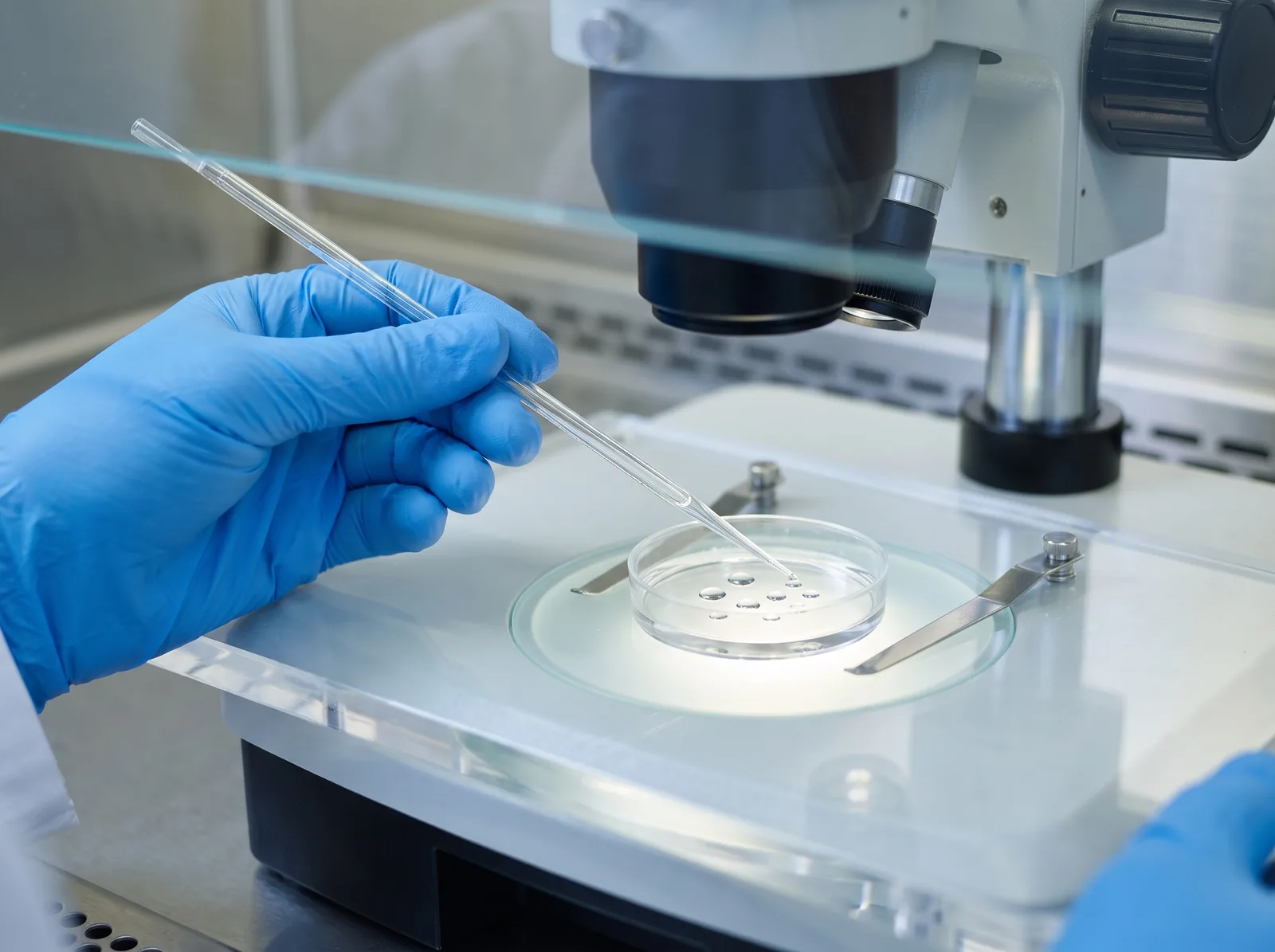
Egg collection is done under intravenous sedation.1 A thin needle guided by ultrasound is used to collect the fluid from the follicles, and the eggs are identified in the laboratory. Medication to support the uterine lining is usually started around this time.

Sperm sample
The male partner gives a semen sample on the day of egg collection, usually after 2 to 5 days of abstinence. If there is no sperm in the semen or the sample is limited, sperm can be collected from the testis or related tissue (for example TESA or micro-TESE).2 Leftover material is stored for the period allowed by regulation.3
Laboratory phase
Eggs are kept in an incubator for a few hours and prepared for fertilization. Depending on the semen analysis and the previous history, conventional IVF or microinjection (ICSI) is used. Fertilization is checked the next morning, and the development of the embryos is followed over the next days.4 Some laboratories use incubators with a built-in camera (time-lapse) for follow-up.5
Embryo transfer
Transfer is usually done on day 2 to 3 or on day 5 (blastocyst stage), as decided by the physician and embryologist.6 It is done with a thin catheter under ultrasound guidance, generally without anaesthesia. Progesterone medication is continued until the pregnancy test.7
Freezing of embryos and eggs
Suitable embryos that are not transferred can be frozen (cryopreservation) and used in a later cycle.8 Freezing can also be used when the uterine lining is not suitable or when there is a medical reason to delay the transfer. Egg freezing may be considered for medical reasons, for example before a treatment that may harm the ovaries. Storage times follow legal regulations.3
Pregnancy test
A blood test (beta-hCG) is done about 15 days after egg collection and may be repeated after two days. If the result is positive, an ultrasound is planned about two weeks later. Progesterone medication may be continued during the first months as instructed by the physician.
References
- National Institute for Health and Care Excellence (NICE). Fertility problems: assessment and treatment. NICE guideline NG257. 2026.
- European Association of Urology. EAU Guidelines on Sexual and Reproductive Health. Arnhem: EAU Guidelines Office; 2025.
- Republic of Türkiye Ministry of Health. Regulation on Assisted Reproductive Treatment Practices and Assisted Reproductive Treatment Centres (Üremeye Yardımcı Tedavi Uygulamaları ve Üremeye Yardımcı Tedavi Merkezleri Hakkında Yönetmelik). Official Gazette, 30.09.2014, No. 29135 (as amended).
- ESHRE Special Interest Group of Embryology and Alpha Scientists in Reproductive Medicine. The Vienna consensus: report of an expert meeting on the development of ART laboratory performance indicators. Reproductive BioMedicine Online. 2017;35(5):494–510.
- Armstrong S, Bhide P, Jordan V, Pacey A, Marjoribanks J, Farquhar C. Time-lapse systems for embryo incubation and assessment in assisted reproduction. Cochrane Database of Systematic Reviews. 2019;(5):CD011320.
- Glujovsky D, et al. Blastocyst-stage versus cleavage-stage embryo transfer in assisted reproductive technology. Cochrane Database of Systematic Reviews. 2026. CD002118.pub7.
- van der Linden M, Buckingham K, Farquhar C, Kremer JA, Metwally M. Luteal phase support for assisted reproduction cycles. Cochrane Database of Systematic Reviews. 2015;(7):CD009154.
- Rienzi L, Gracia C, Maggiulli R, et al. Oocyte, embryo and blastocyst cryopreservation in ART: systematic review and meta-analysis comparing slow-freezing versus vitrification to produce evidence for the development of global guidance. Human Reproduction Update. 2017;23(2):139–155.
Related topics
- What is infertility and in vitro fertilization?
- Pre-assessment before IVF
- When is IVF considered?
- Starting the treatment
- Ovarian stimulation and monitoring
- Practices before and during IVF
- Recommendations during treatment
- Preimplantation genetic testing
- What is ICSI?
- Embryo development and the blastocyst stage
- Frozen embryo transfer
This page gives general information only. It does not replace an examination, and the treatment plan is decided by the physician for each person individually.