
IVF guide
Frozen embryo transfer
In a frozen embryo transfer (FET), an embryo that was frozen in an earlier IVF cycle is thawed and placed in the uterus. The transfer usually takes place in a later month.
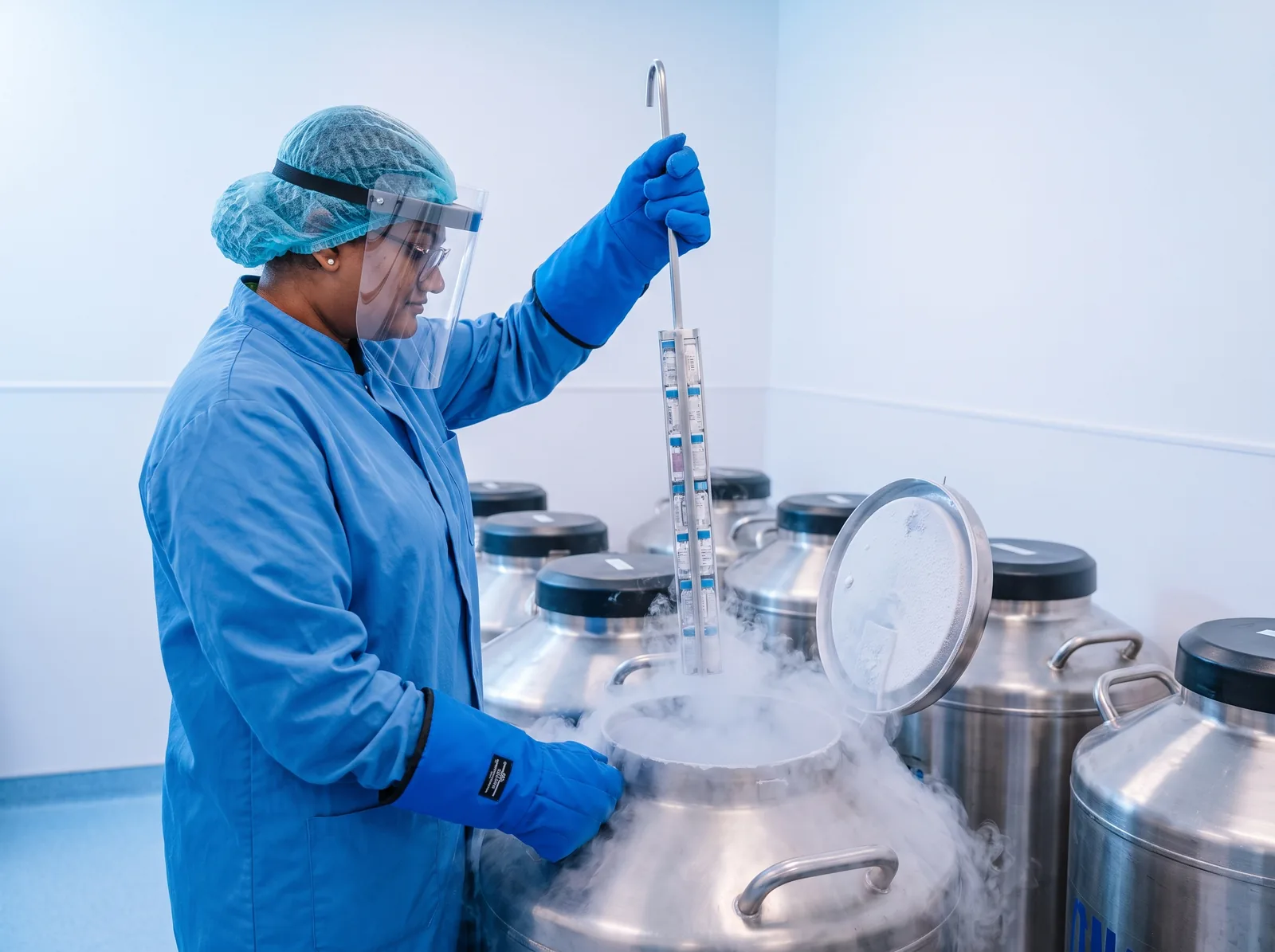
How embryos are frozen
Embryos that are suitable but not transferred may be frozen. Most laboratories use vitrification: the embryo is placed in a protective solution and cooled very quickly in liquid nitrogen, so that ice crystals do not form.1 The frozen embryos are labelled and kept in storage tanks at about minus 196 °C.

Why all embryos may be frozen
Sometimes no fresh transfer is done in the stimulation cycle and all suitable embryos are frozen. Possible reasons include:
- A high risk of ovarian hyperstimulation syndrome (OHSS)2
- Waiting for the results of preimplantation genetic testing
- A uterine lining or hormone level that is not considered suitable for transfer
- A medical or personal reason to postpone the transfer
Preparing the uterus
Two approaches are common. In a natural cycle, ovulation is followed with ultrasound and blood tests, and the transfer is timed accordingly. In a medicated cycle, estrogen is given to build the uterine lining, and progesterone is added before the transfer. The physician chooses the approach according to the cycle pattern and history.3
The transfer day
The embryo is thawed in the laboratory a few hours before the transfer, and the embryologist checks that it has survived. The transfer is done with a thin catheter, usually under abdominal ultrasound guidance, and generally does not require anaesthesia. Progesterone support is usually continued until the pregnancy test.4
Storage of embryos in Turkey
Embryo storage in Turkey follows the regulations of the Ministry of Health. Written consent of both partners is required, and the storage period is limited and must be renewed on request.5 The treatment centre explains the current rules and documents.
At a glance
- Embryos are frozen with a fast method called vitrification.
- The uterus is prepared with a natural cycle or with medication.
- The transfer itself is similar to a fresh transfer.
- Storage periods are set by Turkish regulations.
Frequently asked questions
Most vitrified embryos survive thawing, but not all.1 The embryologist checks the embryo before the transfer.
The transfer is usually similar to a cervical smear test and generally does not need anaesthesia.
No. In Turkey, embryos can only be used by the married couple they belong to. Embryo donation is not permitted.5
References
- Rienzi L, Gracia C, Maggiulli R, et al. Oocyte, embryo and blastocyst cryopreservation in ART: systematic review and meta-analysis comparing slow-freezing versus vitrification to produce evidence for the development of global guidance. Human Reproduction Update. 2017;23(2):139–155.
- ESHRE Guideline Group on Ovarian Stimulation, Ata B, et al. ESHRE guideline: ovarian stimulation for IVF/ICSI: an update in 2025. Human Reproduction. 2026;41(4):498–514.
- Ghobara T, Gelbaya TA, Ayeleke RO. Cycle regimens for frozen-thawed embryo transfer. Cochrane Database of Systematic Reviews. 2017;(7):CD003414.
- van der Linden M, Buckingham K, Farquhar C, Kremer JA, Metwally M. Luteal phase support for assisted reproduction cycles. Cochrane Database of Systematic Reviews. 2015;(7):CD009154.
- Republic of Türkiye Ministry of Health. Regulation on Assisted Reproductive Treatment Practices and Assisted Reproductive Treatment Centres (Üremeye Yardımcı Tedavi Uygulamaları ve Üremeye Yardımcı Tedavi Merkezleri Hakkında Yönetmelik). Official Gazette, 30.09.2014, No. 29135 (as amended).
Related topics
This page gives general information only. It does not replace an examination, and the treatment plan is decided by the physician for each person individually.